Smile aesthetics
Porcelain veneers for white spots: when to consider?
White spots on enamel have different causes. Understand why diagnosis comes before porcelain veneers and what alternatives can be discussed, with the limits of the available evidence.
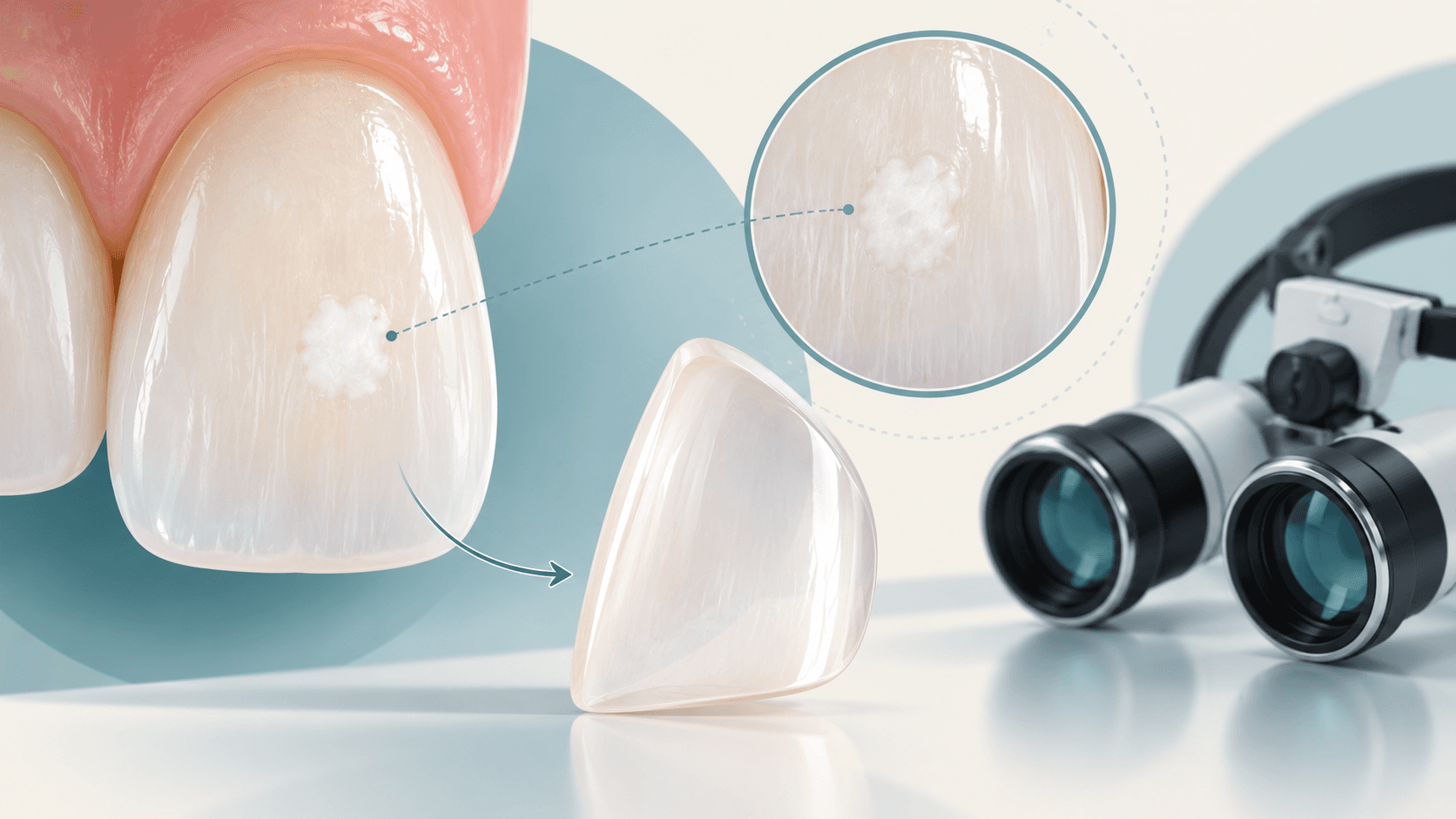
Porcelain veneers can be considered in some planning for white spots, but they are not the automatic answer to every stain. First, it is necessary to identify the cause, check if there is an active disease and discuss more conservative alternatives; only an individual examination allows you to evaluate the indication and need for wear.
Diagnosis Changes the Conversation About Treatment
White spots do not form a single diagnosis. The dentist considers history, time of appearance, distribution, and clinical features to differentiate non-cavitated caries lesions from developmental changes, among other possibilities. Isolated appearance does not confirm fluorosis or exclude caries; evaluation may require follow-up.
If the stain corresponds to an active caries lesion, the priority is to control the disease and preserve tooth structure. An aesthetic veneer is not a substitute for managing the cause. If it is a developmental stable change, the conversation can focus on aesthetic perception, options, and their limits.
What options can be discussed before a veneer
Depending on the diagnosis, depth, and extent, follow-up, control of risk factors, and minimally invasive approaches, such as resin infiltration or microabrasion in selected situations, can be evaluated. This does not mean that they are suitable for all types of opacity or that they guarantee the disappearance of the stain.
A systematic review and meta-analysis published in 2026 brought together 29 clinical studies on resinous infiltration in white spot lesions. The results were inconsistent and heterogeneous, with generally small samples and limited follow-ups. Therefore, the evidence does not allow us to promise stability or an equal aesthetic result for all people.
When porcelain veneers enter the discussion
Ceramic veneers can be discussed when the individual assessment indicates that an indirect restoration is appropriate and the person understands alternatives, limits, and maintenance. A 2021 comparative clinical study on fluorosis followed 64 people (328 teeth) for 24 months: the groups received either direct resin or porcelain veneers and both had favorable evaluations; reported satisfaction was higher in the porcelain group.
This study is a clinical note, it does not prove that porcelain is the best choice for everyone: the groups were not described as drawn, the follow-up was two years, and its results should not be generalized to other causes of stains or to each patient. It does not compare veneers with infiltration or microabrasion.
Veneers may require tooth preparation and involve a restoration that will need to be monitored. Ask if there is an alternative that preserves more enamel in your case, what wear is expected and how costs, maintenance, repairs and replacements will be explained. Do not accept a promise of treatment without evaluation and individual plan.
Useful questions to bring to the consultation
What is the diagnostic hypothesis for each spot and how was it established? Is there caries activity that needs to be controlled before thinking about aesthetics?
Which options preserve the most structure in my case? What can and cannot each change, and what is the quality and length of follow-up of the evidence?
If a veneer is indicated, how much preparation is foreseen and what consequences, care and maintenance possibilities should I understand before deciding? Ask for the plan to be explained without treating the illustration or simulation as a guarantee of the result.
In summary, porcelain veneers may be part of the conversation about some white spots, but diagnosis and comparison with alternatives come first. Available clinical research on fluorosis veneers is limited; studies of conservative options also present uncertainties. The decision depends on the examination, the cause of the stain, the goals, and the person's informed choice.
Frequently asked questions
Doubts that help prepare the conversation.
Can every white spot be treated with a porcelain veneer?
No. The cause and activity of the lesion need to be evaluated. Some spots may correspond to initial caries or enamel alterations with different conducts; the indication of veneer is individual.
Is there a less invasive option?
Depending on the diagnosis, strategies for control, follow-up, resinous infiltration, or microabrasion may be discussed. Adequacy and outcome vary and cannot be defined without examination.
Does research prove that porcelain veneers are better for fluorosis?
No. There is a comparative clinical score of 64 people with a 24-month follow-up, but its limits prevent generalizing a superiority for all cases or comparing it with conservative approaches.
Traceability
Sources
- Outcomes of resin infiltration for white spot lesions at different time points: a systematic review and meta-analysisStåhl L, Papageorgiou SN, Westerlund A, Naoumova J; European Journal of Orthodontics, 2026; systematic review and meta-analysis
- A Comparative Study of Direct Resin Veneers and Porcelain Veneers in the Esthetic Restoration of Anterior Teeth with Dental FluorosisZeng C; Journal of Hard Tissue Biology, 2021; comparative clinical note
- Clinical evaluation of resin infiltration and microabrasion in postorthodontic white spot lesions: randomized controlled clinical trialGu X et al.; randomized clinical study on postorthodontic lesions, 2019
- Differential diagnosis of developmental defects of enamel: a reviewSilva MJ et al.; Review on differential diagnosis of enamel defects, 2021