Smile aesthetics
Can porcelain veneers change speech? What the evidence shows
Changes in the shape or position of the front teeth can influence some sounds, but the available research does not allow us to say that porcelain veneers usually alter speech or predict the effect on a person.
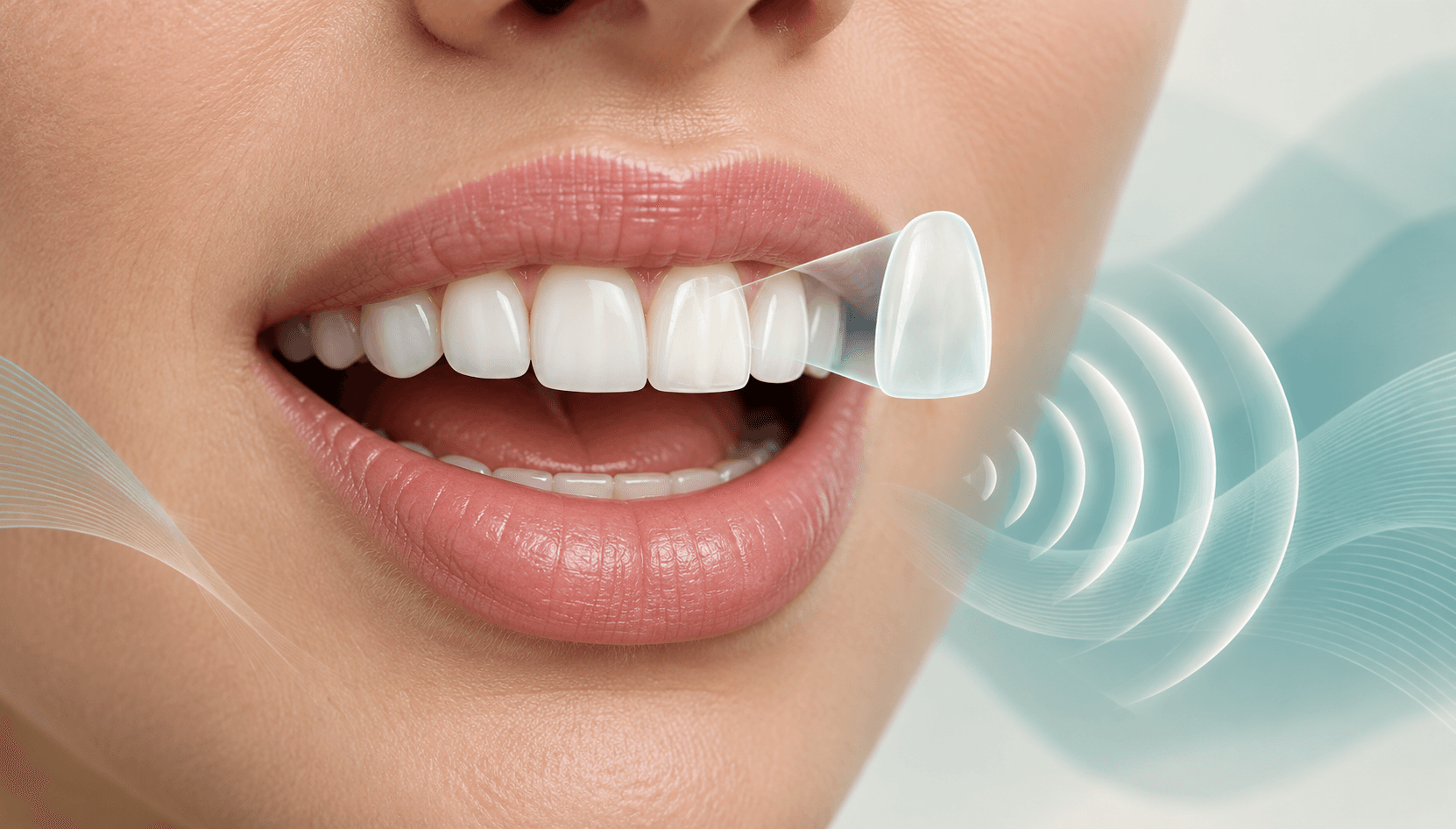
It is possible that a restoration in the front teeth influences the pronunciation of some sounds, especially when it changes the contour or the relationship between the incisors. But the available studies are small and investigate varied anterior restorations; they do not show that every porcelain veneer alters speech, nor does it allow us to estimate how often this happens.
What research on previous restorations has found
In a case series published in 2025, eight people who needed ceramic restorations on the upper incisors tried dentures with different tooth ratios. The researchers recorded changes in acoustic characteristics of the sound /s/ associated with these changes. The sample was small, spoke Mandarin, and evaluated previous fixed dentures under controlled conditions; the study does not measure the frequency of changes after routine porcelain veneers nor does it predict what will occur to each patient.
A Brazilian study published in 2008 followed people with wear on their front teeth before and after a stabilizing plate and direct reconstructions in composite resin. In this group, the mandibular movements measured during the pronunciation of /m/ and /s/ did not change after reconstruction. The study did not study ceramic veneers and combined more than one treatment step, so it does not answer the question about veneers on its own.
Why Tooth Drawing Can Enter the Speech Conversation
The production of sounds involves the tongue, lips, jaw, and the space where air passes. For /s/, for example, the relationship between the tongue and the edges of the front teeth participates in the formation of airflow. Changes in contour, length, or position can change this space; the response, however, varies and should not be assumed without evaluation.
What to inform before planning veneers
In the consultation, explain if your speech has specific requirements at work, in study or in everyday activities, and if you already notice any pronunciation difficulties. Ask how the planning considers function and phonetics along with appearance, and what stages of test or evaluation will be available in your case. This helps align expectations; it does not guarantee a specific result.
If you notice a change after placement
Communicate the change to the dentist who accompanies the treatment, describing when it began and what sounds or situations draw attention. The professional may examine the filling, the bite, and other relevant factors before deciding whether any adjustments or other evaluation are indicated. A change in speech should not be automatically attributed to the veneer because there are other possible causes.
What cannot yet be concluded
The publications consulted do not establish a rate of speech alterations after porcelain veneers, how long it takes to adapt or which design avoids the problem in all people. A small series with previous prostheses and a study of resin reconstructions do not replace specific clinical evidence on ceramic veneers. Indication and planning depend on individual examination.
In summary, pronunciation changes are a possibility to discuss when planning changes to the anterior teeth, but they are not an inevitable effect demonstrated for porcelain veneers. Take your concern to the appointment, ask for explanations about the functional assessment, and see the dentist if a change persists after treatment.
Frequently asked questions
Doubts that help prepare the conversation.
Can every person who puts a porcelain veneer have a different speech?
There is no evidence to affirm this. The available studies are small and do not establish the frequency of changes after porcelain veneers; the answer depends on the case and the design of the restoration.
What sounds were evaluated in the research?
A case series of previous ceramic restorations evaluated acoustic characteristics of /s/. A Brazilian study in people with anterior wear measured mandibular movements during /m/ and /s/ before and after resin reconstructions, finding no change in these movements after reconstruction.
What to do if I notice a change in pronunciation after treatment?
Notify the dentist in charge and describe when the change began and which sounds you perceive different. Only an evaluation can clarify if the restoration is related and if any conduct is indicated.
Traceability
Sources
- Impact of Aesthetic Restoration on /s/ Acoustic Characteristics and Mandibular Speech Movements: A Case SeriesLiu R, Hu A, Wu L, Niu L, Zhou Q; Journal of Advanced Oral Research, 2025; Case Series
- Effect of dental wear, stabilization appliance and anterior tooth reconstruction on mandibular movements during speechSerrano PO et al.; Brazilian Dental Journal, 2008; clinical study with previous resin reconstruction