Smile aesthetics
Does old resin restoration prevent porcelain veneer?
Having an old resin restoration does not automatically preclude a porcelain veneer. The condition of the restoration, the available enamel, and the area of adhesion need to be evaluated tooth-by-tooth.
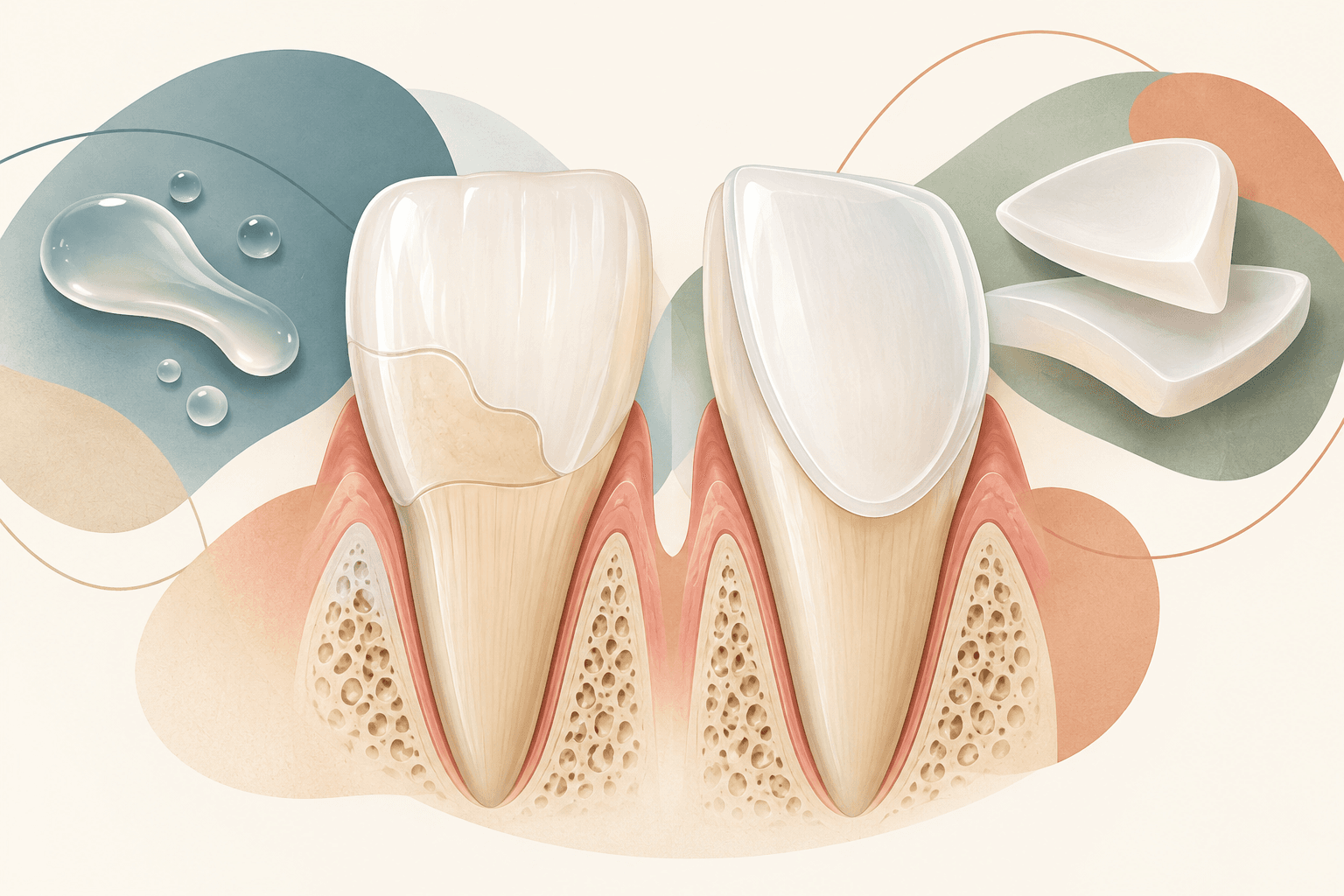
An old resin restoration does not automatically preclude a porcelain veneer, but it should not be ignored in planning either. The decision depends on the condition of the restoration, how much enamel and dentin will be available, and where the future veneer will end up. Only clinical examination allows you to evaluate these characteristics in each tooth.
Does the old restoration need to be removed before veneer?
Not always. In a prospective study published in 2019, resin restorations that had quality considered acceptable were maintained and prepared for adhesion according to the researchers' protocol. This shows that the presence of resin did not lead to automatic removal in that sample; it does not allow us to conclude that every old restoration is suitable to receive ceramics.
Why does the material that lies under the veneer matter?
Veneers can bond to different surfaces, but clinical evidence does not treat enamel, exposed dentin, and composite resin as equivalent substrates. A systematic review published in 2025 brought together six clinical studies and found different results depending on the adhesion surface. The included studies varied in technique, follow-up, and conditions; the estimates describe those studies, they do not predict the duration of an individual veneer.
What the dentist needs to examine
- If the restoration is intact or has infiltration, fracture, wear or recurrent caries.
- The extent and position of the resin in relation to the planned area of the veneer.
- How much enamel and dentin will remain after the proposed preparation.
- Whether the color of the tooth and the restoration can influence aesthetic planning.
- Like the bite, gum health and restorative alternatives come into the decision.
Maintain, repair, replace, or choose another alternative
When there is a restoration, the conversation does not have to be limited to covering it with a veneer. The professional can explain if it requires repair or replacement, if a direct restoration is an alternative, or if another type of rehabilitation fits the remaining structure better. Each option has limits and consequences; the choice should not be made only by age or the color of the resin.
Useful questions before deciding
- Is the restaurant healthy? How was this evaluated?
- Why would it be kept or removed in this tooth?
- On which surfaces will the veneer be adhered after preparation?
- Which alternatives retain the most structure and what are their limits?
- What repairs or follow-ups may be needed in the future?
What the evidence does not allow us to promise
The available studies investigate specific patient groups and protocols. They do not confirm, without examination, whether a restoration is adequate, whether a veneer is indicated, or how long it will last. If the restoration is broken, painful, or suspected of decay, the priority is dental evaluation before any aesthetic decision.
In summary, the presence of old resin is a planning datum, not a ready-made answer. Ask the dentist to show the condition of the restoration, explain the substrate expected for adhesion, and compare the veneer with less intervention options when relevant.
Frequently asked questions
Doubts that help prepare the conversation.
Can you put a porcelain veneer over a resin restoration?
In some cases this has been studied, but it is not possible to decide on the presence of the resin alone. The state of the restoration, its extent and the surface available for adhesion need to be examined.
Does every old restoration need to be removed before the veneer?
There is no automatic rule. Removing or keeping depends on the clinical condition and the restorative plan for that tooth; studies do not authorize an equal response for all people.
Does resin restoration change veneer durability?
Evidence indicates that substrate may influence outcomes, but studies vary and do not predict duration in the individual case. The dentist should explain the conditions and limits of the proposed plan.
Traceability
Sources
- Clinical survival and complication rate of ceramic veneers bonded to different substrates: A systematic review and meta-analysisAlqutaibi AY et al.; The Journal of Prosthetic Dentistry / PubMed; systematic review published in 2025
- Performance of ceramic laminate veneers with immediate dentine sealing: An 11 year prospective clinical trialGresnigt MMM et al.; Dental Materials / PubMed; Prospective clinical study
- A prospective ten-year clinical trial of porcelain veneersLayton D, Walton T; International Journal of Prosthodontics / PubMed; Prospective Clinical Study