Smile aesthetics
Professional cleaning with porcelain veneers: what does the evidence show?
Having porcelain veneers does not mean that you should abandon dental follow-up. Understand what laboratory studies have observed about prophylaxis and why they do not prove clinical damage in every cleaning.
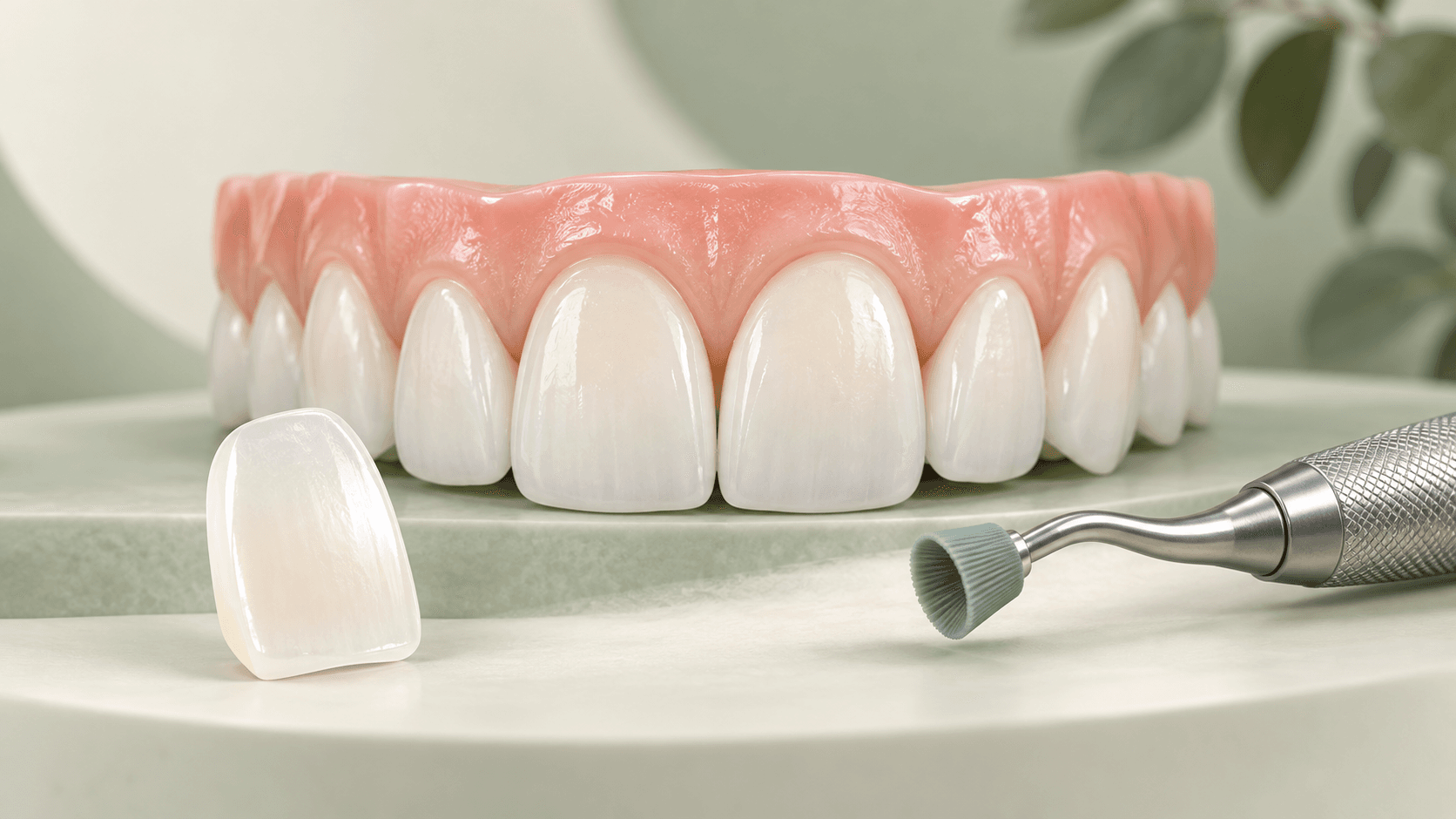
Having porcelain veneers is not, in itself, a reason to skip appointments or dispense with the professional cleaning indicated for your oral health. Laboratory studies have evaluated how some procedures affect veneer materials, but do not demonstrate that a cleaning causes clinical damage in all people. The dental team must consider the type of restoration and the situation of the mouth.
Does the presence of veneers prevent professional cleaning?
There is no basis in these studies to conclude that every person with ceramic veneers needs to avoid prophylaxis. The Ministry of Health includes prophylaxis among the oral health procedures offered in SUS Primary Care. The need, timing, and form of each service depend on the dental evaluation.
What have veneer studies observed?
In a 2024 study, researchers evaluated 32 premolars extracted with lithium disilicate or zirconia-reinforced lithium silicate veneers. After artificial cycles of aging and prophylaxis, they observed changes in the interface of the restorations; they did not identify a change in surface texture. Cracks appeared in part of the samples of a material submitted to ultrasound. Since the experiment was done outside the mouth, these results do not estimate the clinical risk of a cleaning in patients.
A 2023 laboratory study examined other veneer materials, including composite and a polymer-infiltrated ceramic net. The effects varied by material and procedure; there was an increase in roughness in some samples after ultrasound. The difference between materials reinforces why an isolated result should not become a rule for all veneers.
What the results do not allow us to say
The studies analyzed teeth extracted under controlled conditions and microscopic measurements, such as roughness, interface, and cracks. They did not accompany people during routine cleanings and do not demonstrate that a veneer will loosen, break, or need to be replaced. Nor do they establish a single instrument or protocol suitable for all materials and situations.
What to inform the team before the service
Communicate that you use veneers or veneers and, if you do, inform the material and when they were installed. Also communicate if you notice a rough edge, loose piece, crack, discomfort or change in the gum. These reports do not identify the cause, but help the team to assess the context before defining care. Do not try to choose or adjust instruments on your own.
Cleaning, monitoring and maintenance are different decisions
Veneers are not a substitute for daily hygiene or the evaluation of the health of the teeth and gums. The frequency of consultations is individual; the studies cited do not define a return interval. To understand the general care and duration limits of restorations, also see the article on how long a porcelain veneer lasts and its care.
Frequently asked questions
Does ultrasound always damage porcelain veneers?
It is not possible to say this based on the available studies. The results cited are from the laboratory, vary between materials and do not prove clinical damage in all cleaning. The team evaluates the case and defines the procedure.
Should I cancel the cleaning because I have veneers?
Don't make this decision just because of the presence of veneers. Oral health monitoring remains important; talk to the team about restorations and follow the guidance set for you.
Sources and further reading
The sources consulted include the laboratory studies of Fuchs et al. (2024) and Unterschütz et al. (2023), as well as guidance from the Ministry of Health on oral health services. See also the related reading on care and maintenance of porcelain veneers.
Frequently asked questions
Doubts that help prepare the conversation.
Does ultrasound always damage porcelain veneers?
It is not possible to say this with the available studies. The results are laboratory, vary according to the material and do not prove clinical damage in all cleanings. The dental team evaluates each situation.
Should I cancel the cleaning because I have veneers?
Don't just decide on the presence of veneers. Talk to the team, inform them about the restorations, and follow the follow-up plan indicated for you.
Traceability
Sources
- Effect of powder air polishing and ultrasonic scaling on the marginal and internal interface (tooth-veneer) of ceramic veneers: an in vitro study — Fuchs et al., 2024Clinical Oral Investigations / Springer Nature
- Influence of dental prophylaxis procedures on the tooth veneer interface in resin-based composite and polymer-infiltrated ceramic veneer restorations: an in vitro study — Unterschütz et al., 2023Clinical Oral Investigations / PubMed Central
- What oral health services are offered in the SUS?Ministry of Health
- Read also: How long does a porcelain veneer last? Care, scratches and maintenanceBlog Dr. Rodolfo Segawa