Smile aesthetics
Is a wooden toothpick used to clean between teeth?
Understand why the common wooden toothpick is not suitable for cleaning between the teeth and how to differentiate with a floss with support and an interdental brush.
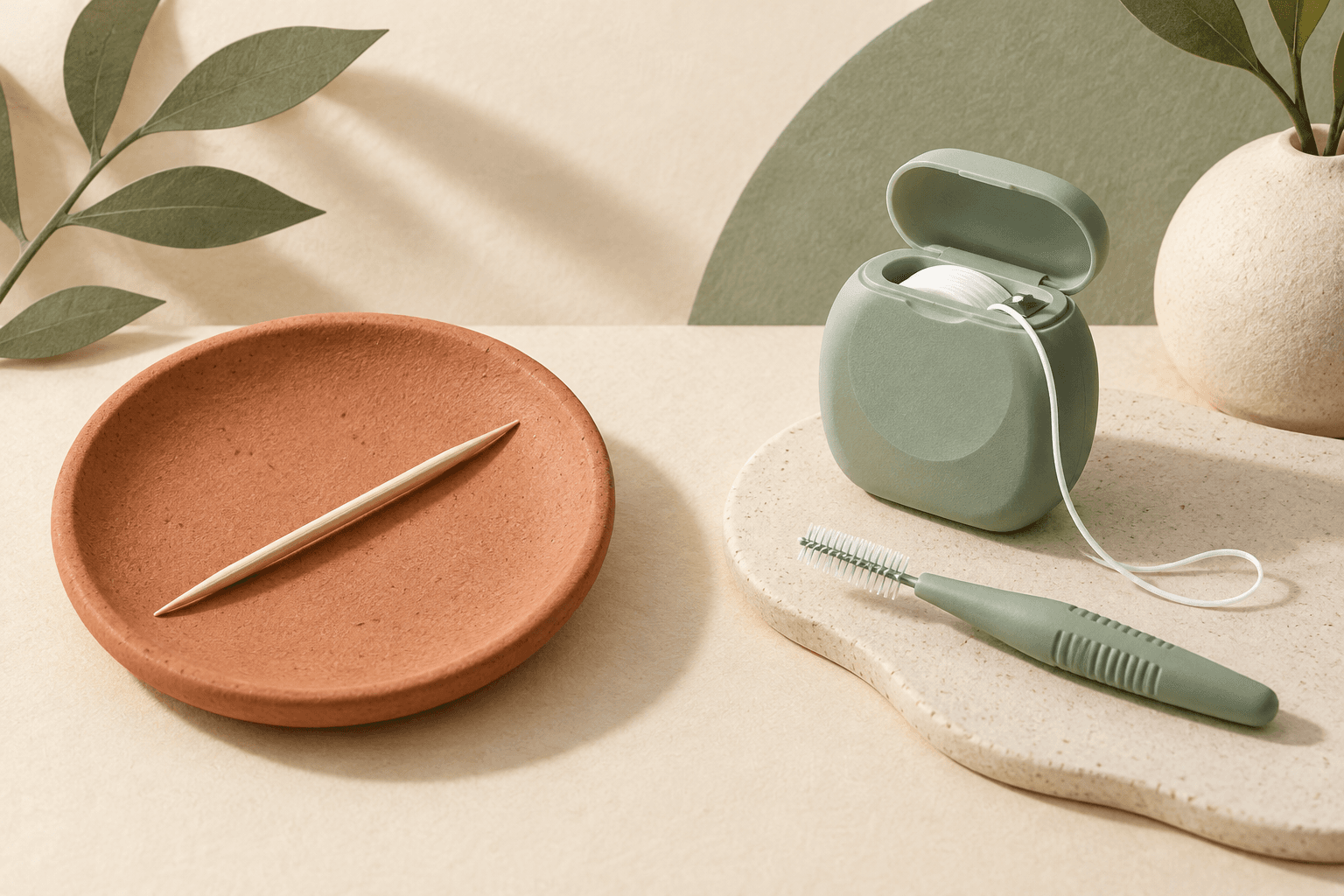
The common wooden toothpick is not a good choice for daily cleaning between the teeth. The NHS, the British public health service, advises against its use to remove stuck food because it can hurt the gums. Dental floss and other devices suitable for interdental cleaning should be chosen according to the spaces and the dentist's guidance.
Removing a piece of food is not all cleaning
Hygiene between the teeth also seeks to remove plaque that accumulates in these regions. The NHS explains that flossing is not only for dislodging visible residues. Therefore, feeling that the food has come out does not mean that the cleaning of the space is complete. Brushing and care between the teeth fulfill complementary functions.
What are the problems of wooden toothpick?
The Australian Dental Association warns that frequent or sudden use can damage the gums. The toothpick can also break or loosen splinters that get stuck in the tissue. It is not necessary to wait for this to happen to change the habit: there are instruments designed specifically for the hygiene of these spaces.
Is a wire with support the same thing as a toothpick?
No. The supported floss has a small segment of dental floss attached to a rod. The Australian association describes it as an option for those who have difficulty holding or reaching their teeth with conventional floss. The existence of a rod does not make the product equivalent to a wooden toothpick: note which part was made to clean and ask for a demonstration of use.
And the interdental brush?
This small brush comes in different sizes. According to the Australian Dental Association, its bristles should occupy the space comfortably, without having to force their way in. The same person may need more than one size. Your dentist can help you choose and show you the technique, especially when conventional floss is difficult to use.
How to change the habit in practice
- Leave the indicated hygiene instrument in an accessible place for your routine.
- In the consultation, show in which region it is difficult to clean and ask for a demonstration.
- Do not force objects against the gums to reach a residue.
- If a stuck barb, pain, or persistent bleeding is suspected, seek evaluation rather than continue poking.
The choice of instrument depends on your mouth and ease of use. This text deals with the common wooden toothpick; it is not intended to replace individual guidance on specific dental devices. To organize the sequence of the routine, also refer to the related reading on dental floss before or after brushing.
Frequently asked questions
Doubts that help prepare the conversation.
Is dental floss with support the same as wooden toothpick?
No. It holds a segment of wire attached to a rod to aid cleaning. Ask for guidance on the proper way to use the instrument.
Can I force the interdental brush when it doesn't go in?
No. The brush must be a size appropriate for the space and enter with light pressure. The dentist can guide the choice.
Traceability
Sources
- How to keep teeth clean — guidance on toothpicks and interdental hygieneNHS — review of 30/06/2025
- Flossing — Interdental Cleaning Options and Stick BoundariesAustralian Dental Association
- Related Reading: Flossing Before or After BrushingBlog Dr. Rodolfo Segawa