Implants and rehabilitation
Dental implant or bridge: what to consider when replacing a tooth?
Implant and dental bridge have different supports, steps and care. Understand what to evaluate with the dentist before choosing how to replace a lost tooth.
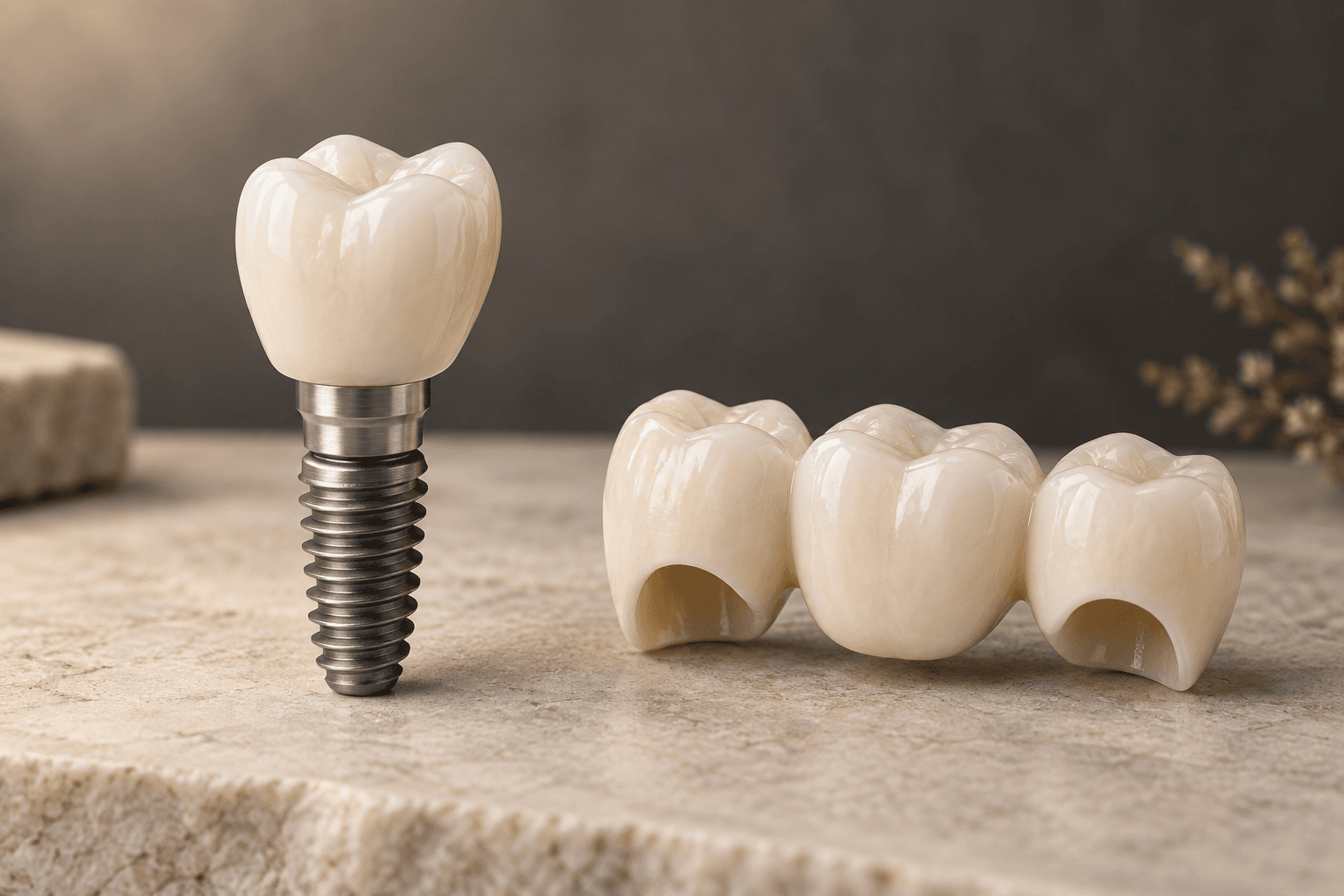
The choice between implant and dental bridge depends on the conditions of the mouth, neighboring teeth, and individual planning. Both options can replace missing teeth, but they use different support structures. Therefore, comparing only the final appearance or the price does not clarify all the steps involved.
How does a dental bridge work?
The bridge occupies the space of one or more missing teeth. In the tooth-supported modality, neighboring elements support the prosthesis. Depending on the design chosen, it may be necessary to prepare them. The American Dental Association highlights that the health of the supporting teeth is important for the result. A fixed bridge is not removed by the patient for cleaning; access to the region needs to be explained in the consultation.
What changes when the support is an implant?
The implant is installed in the bone and can support a crown, bridge, or other type of prosthesis. According to Cambridge University Hospitals, this alternative can replace a tooth without preparing the teeth next to it. It involves evaluation for surgery, proper hygiene conditions, and monitoring healing. The number of steps and the deadline vary; it is not possible to define on the internet whether there will be a need for additional procedures.
Are bridge and implant always competing options?
No. There are also bridges supported on implants. It is useful to separate two questions: which structure will support and which prosthesis will replace the teeth? The NHS also describes removable prostheses among the replacement alternatives. The indication should consider the whole mouth and the possibilities of each person, without treating a technique as a universal solution.
What to ask before deciding?
Ask the dentist to explain which teeth will be involved, if there will be surgery, which tests answer the questions in the case, and how hygiene will be. Request a plan with steps, alternatives, and costs itemized. Another useful question is how the follow-up will be and what to do if discomfort arises. These answers make different proposals easier to compare.
Maintenance is part of the treatment
Planning should include daily cleaning and professional-guided returns. Support teeth, gums, and tissues around implants need follow-up. At the appointment, take previous exams and inform your health history. This content is educational: the appropriate option can only be defined after dental evaluation.
Frequently asked questions
Doubts that help prepare the conversation.
Does every lost tooth need an implant?
No. Removable bridges and prostheses may also be considered, depending on the assessment and needs of the case.
Can a bridge be supported on implants?
Yes. Bridge describes a prosthesis that replaces teeth; its support can be on teeth or implants.
Is it possible to choose just by comparing the price?
The budget must be analyzed along with the indication, the steps, the teeth involved and the expected follow-up.
Traceability
Sources
- BridgesAmerican Dental Association
- Dental implants in restorative dentistryCambridge University Hospitals — NHS
- Dental treatmentsNHS